
BioSonic vs SonoChiro: automatic bat identification compared
SonoChiro is Windows software from the French environmental consultancy Biotope that automatically finds and classifies bat calls, with classifiers for 111 species across Europe, the British Isles, the Amazon Basin and the Lesser Antilles. BioSonic is a Swedish platform that identifies European bat species in the web browser, with nothing to install, and lets a whole team review the results together. No published benchmark has compared the two, so the best test is to run both on recordings you have already identified.
Both tools do the same core job: turn a large pile of detector recordings into species lists that a person then checks. They differ in where the analysis runs, how teams share the work and which regions they cover. Below we set out the facts, with sources.
At a glance
Facts about SonoChiro come from Biotope's own product pages and from Pettersson Elektronik, which also sells it, linked in the references. Prices are left out; ask each supplier for a quote.
| Feature | BioSonic | SonoChiro |
|---|---|---|
| What it is | Cloud platform for automatic bat species identification and team review | PC software that automatically finds bat calls in recordings and classifies them [1][3] |
| Made by | Biosonic AB, Stockholm, Sweden (founded 2024) | Biotope, a French environmental consultancy [1][4] |
| Updates | New AI model every weekend, used automatically | Version 4, which added the SonoView module; updates included in the licence [1] |
| Platform | Web browser on any operating system; nothing to install | Windows PC; for version 4 Biotope recommends a Core i7 and 16 GB of RAM [1][2] |
| Works offline | No, analysis runs on BioSonic's servers | Yes, with an online licence check every 30 days [1] |
| File formats | WAV and FLAC from full-spectrum detectors, any file length; Anabat zero-crossing (.zc, .NN#) decoded on upload | WAV and batcorder RAW; Biotope recommends 5-second segments, and the SonoDemux module can cut long files and split stereo [1][2] |
| Species coverage | European bat species, including France; Myotis to species and Plecotus sent to manual verification | 111 species from Europe, the British Isles, the Amazon Basin and the Lesser Antilles, with eight regional classifiers [1] |
| Confidence information | Confidence score for every call | A set of confidence indices for each identification [1][3] |
| Behaviour | Feeding buzzes and social calls flagged automatically | Hunting activity (prey capture) and social activity highlighted [1][3] |
| Reviewing results | Interactive spectrogram review in the browser; confirm or correct each call, with an audit trail | SonoView shows sonograms, sorts noise and species, and opens files in BatSound, Syrinx or Audacity [1] |
| Output | Detection tables, charts, maps and reports; dated CSV and Excel exports | CSV and SQLite files [1] |
| Team working | Whole team on one organisation account, shared projects | Single-user licence [1] |
| Pricing model | Package of analysis GB, lower price per GB for bigger packages; recordings kept for 9 years; ask us for a quote | Single-user licence for one or three years, updates included; academic rate available; ask Biotope [1][2] |
| Published accuracy | 98.7% F1 in a third-party benchmark by Wilder Sensing, against 83.0% for Kaleidoscope Pro | Not in that benchmark; a 2017 peer-reviewed test of version 3.3.3 found results varied widely by species [5] |
How each tool works
SonoChiro: automatic analysis on your own PC
You install SonoChiro on a Windows computer, choose a regional classifier and point it at a folder of recordings. It finds the files that contain bat calls, proposes a genus and species for each, and reports behaviour such as hunting and social activity, with confidence indices for each identification [1][3]. Biotope suggests it for stand-alone recorders that collect large volumes of data, and names the SMXBAT, Pettersson D500X, Batlogger and BATMODE as examples [1].
Version 4 added SonoView, a module for looking at the sonogram of each recording, sorting noise and species, and confirming identifications with a low confidence index. From there you can open a recording in BatSound, Syrinx or Audacity to measure it [1]. Results are saved as CSV and SQLite files, and the software is available in French and English [1]. Biotope is clear about its limits: it says SonoChiro cannot completely replace manual identification, because a zero error rate is not achievable [1].
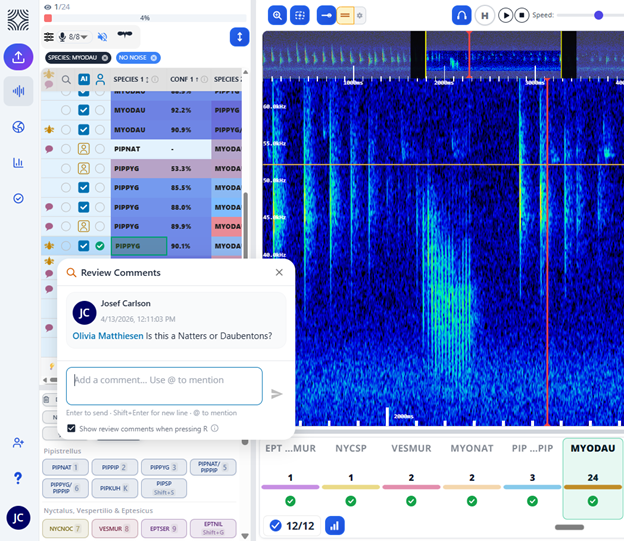
BioSonic: automatic sorting in the browser, human checking
You upload recordings in the browser and the analysis runs on BioSonic's servers. Each recording is turned into a spectrogram and classified by a deep-learning model trained on more than 2.5 million verified bat calls and 3.5 million noise files from across Europe, curated by 12 bat experts. A new model goes live every weekend, so there is nothing to update.
The output is a shared project where noise is filtered out, every call has a species suggestion and confidence score, and feeding buzzes and social calls are flagged. Your team clicks through the spectrograms, confirms or corrects, and every change is recorded against the person who made it. Detection tables, charts, maps and reports come from the same project.
Accuracy and evidence
To be plain about it: there is no benchmark that compares BioSonic and SonoChiro on the same recordings, and we have not run one. Anyone who tells you which is more accurate for your survey area is guessing.
What exists for BioSonic is a third-party benchmark by Wilder Sensing (5,325 predictions), in which BioSonic scored 98.7% F1 against 83.0% for Kaleidoscope Pro on the same data, with 13.4 times fewer false positives and 16.3 times fewer missed bats. SonoChiro was not tested. The method and confusion matrices are on our benchmarks page [9].
For SonoChiro, Biotope says it saves more than 90% of analysis time in general, and more than 99% in many cases, depending on your goals and recording quality [1]. The peer-reviewed test we found is Rydell et al. (2017), which ran SonoChiro 3.3.3, Kaleidoscope Pro and BatClassify on Swedish recordings of seven species. All three always told rain from bat calls, SonoChiro and BatClassify sorted most files to the right species group, and species-level results varied widely between species for all three programs. The authors' advice was to validate classifier output [5]. That test is several versions old, so it says little about SonoChiro 4 today.
French researchers have also used SonoChiro, with a manual check, to identify species in published wind energy work, for example a study of bat activity at height on 48 wind masts in France and Belgium [6].
Every automatic classifier, ours included, has limits. Myotis to species level and the Plecotus group are hard to separate on call alone, so BioSonic sends those to manual verification, in line with the Bat Conservation Trust's expectation that automated identifications are checked by a person [10]. The fair way to choose is to take a set of recordings an expert has already identified, run them through both tools, and compare.
When to choose which
SonoChiro has been around long enough to be tested in a 2017 study and used in French bat research since, and Biotope's classifiers reach beyond Europe. BioSonic is newer and built around the browser, shared projects and a model that is retrained every weekend.
Choose BioSonic if you
- Want nothing to install and no Windows PC sized for analysis
- Work as a team and want everyone in the same projects, with a record of who checked what
- Want noise filtered out and calls sorted by species before anyone opens a spectrogram
- Use a mix of detectors, including Anabat zero-crossing files, and long recordings you do not want to cut up first
- Need detection tables, charts and maps for reports straight from the project
- Want your recordings stored in the EU, mainly in Sweden, and kept for 9 years
Choose SonoChiro if you
- Need to analyse fully offline on your own Windows computer
- Survey in the Amazon Basin or the Lesser Antilles as well as Europe
- Record with a batcorder and want to load its RAW files directly
- Want the interface in French
- Already have years of SonoChiro results and a validation routine built around SonoView
- Work alone, so a single-user licence fits
Using both, or switching
Both tools read full-spectrum WAV files, so you do not have to pick blind. A simple trial: take one finished project that you have already identified with SonoChiro and checked by hand, upload the same WAV files to BioSonic with the free trial, and compare species lists, noise filtering and the time it takes to review. Some teams may keep SonoChiro for offline work or regions outside Europe and use BioSonic for large European datasets that several people need to review.
If you switch, nothing needs converting. Your SonoChiro CSV results stay where they are, and you upload the original recordings to BioSonic as recorded.
Detectors and file formats
BioSonic works with full-spectrum WAV files from AudioMoth, Wildlife Acoustics (Song Meter and Echo Meter), Elekon Batlogger, Titley Anabat and Pettersson Elektronik detectors, uploaded as recorded. It also accepts FLAC, and Anabat zero-crossing files (.zc and .NN# sequence files), which it decodes on upload. Any file length works. For batcorder RAW files, ask us first. Its benchmarked accuracy is for full-spectrum WAV, so record full spectrum where you can.
SonoChiro accepts WAV and batcorder RAW files, can analyse stereo recordings and sounds longer than 5 seconds, and saves results as CSV and SQLite [1][2]. Biotope recommends cutting audio into 5-second segments, keeping each analysis folder to about 20 GB and restarting the PC between analyses, and its SonoDemux module can cut sounds into short sequences and split stereo channels [1].
Pricing model
BioSonic: you buy a package of analysis gigabytes; the bigger the package, the lower the price per GB, and recordings are kept for 9 years. There are no per-seat fees, and your whole team uses one organisation account. Ask for a quote for your volume.
SonoChiro is sold as a single-user licence that runs for one year or three years, with updates included, and Biotope offers a lower rate for academics and students [1][2]. Pettersson Elektronik also sells it in some markets [3]. For current prices and terms, ask Biotope.
Data and collaboration
BioSonic keeps your recordings and results in the EU, mainly in Sweden, with uploaded audio in encrypted storage. You can export your data at any time and ask for full deletion. Everyone in your organisation sees the same projects, and every confirmation or correction is attributed, which gives you an audit trail for reports. See our security page for detail.
SonoChiro runs on your own computer, so recordings stay on your machine; it only needs the internet for the licence check every 30 days [1]. It is licensed to a single user [1], so teams share recordings and exported results through their own folders.
Frequently asked questions
Is there an alternative to SonoChiro?
Yes. BioSonic is a browser-based alternative from Sweden: you upload WAV, FLAC or Anabat zero-crossing files, the AI identifies European bat species and flags feeding buzzes and social calls, and your team reviews the results together online. Other automatic identification tools used in Europe include Kaleidoscope Pro (Wildlife Acoustics), BatExplorer (Elekon), bcAdmin with batIdent (ecoObs), the BTO Acoustic Pipeline and Tadarida, the open-source toolbox used by France's Vigie-Chiro programme. Which one suits you depends on your detectors, your region and how your team works. See our overview of bat identification software.
Which is more accurate for European bats, BioSonic or SonoChiro?
Nobody has published a head-to-head test, so we cannot say. BioSonic scored 98.7% F1 in a third-party benchmark by Wilder Sensing (5,325 predictions), against 83.0% for Kaleidoscope Pro on the same data, with 13.4 times fewer false positives and 16.3 times fewer missed bats [9]. SonoChiro was not part of that benchmark. The peer-reviewed test of SonoChiro we found (Rydell et al. 2017) used version 3.3.3 on Swedish recordings, so it says little about today's version 4 [5]. The fair test is to run both tools on a set of your own recordings that an expert has already identified.
Does SonoChiro run on a Mac?
Biotope's product pages give Windows system requirements and do not mention macOS, so plan on a Windows PC for SonoChiro [1][2]. For version 4, Biotope recommends at least a Core i7 processor and 16 GB of RAM for analyses [1]. BioSonic runs in a web browser on any operating system, with nothing to install, because the analysis runs on BioSonic's servers.
Is SonoChiro the same as Tadarida or Vigie-Chiro?
No. SonoChiro is commercial software from Biotope. Tadarida is a separate open-source toolbox for detecting and classifying sounds in recordings (Bas, Bas and Julien, 2017, LGPL-3.0 licence) [7], and it processes the recordings of Vigie-Chiro, the citizen-science bat monitoring programme run by the Muséum national d'Histoire naturelle in France [8]. Both come out of French bat research, but they are different tools.
Can I use SonoChiro and BioSonic together?
Yes. Both read full-spectrum WAV files, so you can run the same recordings through both and compare, or use one tool for some projects and the other for the rest. If you already check SonoChiro output in its SonoView module, you can review a sample of the same files in BioSonic's spectrogram view before you decide anything.
Does BioSonic identify French bat species?
Yes. BioSonic's model is trained on more than 2.5 million verified bat calls and 3.5 million noise files from across Europe, and it covers countries including France, Belgium, Germany, the Netherlands, the UK and the Nordic countries. Myotis to species level and the Plecotus group are sent to manual verification. BioSonic focuses on Europe; if you also survey in the Amazon Basin or the Lesser Antilles, SonoChiro has classifiers for those regions [1].
Prefer another language? Analyse acoustique des chauves-souris explains BioSonic for consultancies in France, Belgium and Switzerland, in French.
Other comparisons
BioSonic vs Kaleidoscope Pro
Cloud AI vs Wildlife Acoustics' desktop classifier, compared on the same benchmark.
BioSonic vs BatExplorer
Any detector vs Elekon's Windows desktop tool.
BioSonic vs ecoObs batIdent and bcAdmin
Any detector in the browser vs Mac software built around batcorder recorders.
References
- Biotope (Le Club Biotope shop), SonoChiro V4 product page (species, classifiers, formats, SonoView, licence terms, hardware advice): leclub-biotope.com
- Biotope (Le Club Biotope shop), SonoChiro 3-year licence page (system requirements, accepted formats): leclub-biotope.com
- Pettersson Elektronik, SonoChiro product page (made by Biotope; outputs and confidence index): batsound.com/product/sonochiro
- Biotope, company website: biotope.fr
- Rydell, J., Nyman, S., Eklöf, J., Jones, G. and Russo, D. (2017) Testing the performances of automated identification of bat echolocation calls: a request for prudence. Ecological Indicators 78: 416–420. doi:10.1016/j.ecolind.2017.03.023
- Roemer, C., Bas, Y., Disca, T. and Coulon, A. (2019) Influence of landscape and time of year on bat-wind turbines collision risks. Landscape Ecology 34: 2869–2881. doi:10.1007/s10980-019-00927-3
- Bas, Y., Bas, D. and Julien, J.-F. (2017) Tadarida: a toolbox for animal detection on acoustic recordings. Journal of Open Research Software 5(1): 6. doi:10.5334/jors.154; code: github.com/YvesBas/Tadarida-D
- Bas, Y. (2024) Vigie-Chiro presentation, EcoInfo Fair 2024: ecoinfofair2024.sciencesconf.org
- Wilder Sensing, third-party benchmark, 5,325 predictions: biosonic.io/benchmarks
- Bat Conservation Trust, guidelines for passive acoustic surveys of bats in woodland (manual verification of automated identifications): bats.org.uk
Competitor facts last checked: 2026-11-18.
Ready to try it?
See how BioSonic handles your recordings
Upload one project you have already analysed with SonoChiro and compare the results. No installation required.
Questions? Email josef.carlson@biosonic.se