
BioSonic vs BTO Acoustic Pipeline
BTO Acoustic Pipeline was rated lowest of three tools tested by Wilder Sensing because it cannot validate AutoID results in-platform. BioSonic scored 98.7% accuracy, and provides direct spectrogram validation & automatic graphs for consultant reports.
Cloud-based deep learning on spectrograms vs BTO's machine learning classifiers. Same WAV files, different results.
At a glance
| Feature | BioSonic | BTO Acoustic Pipeline |
|---|---|---|
| AI approach | AI image recognition on spectrograms | Random Forest (TADARIDA) for bats; CNN for birds |
| Training data | 2.5M bat calls + 4M noise files | ~170K recordings |
| Benchmarked accuracy | 98.7% F1 — third-party benchmark | No public comparable benchmark |
| Platform | Browser-based — works on any computer | Desktop uploader + cloud |
| Team workflow | Unlimited users, shared projects | No team features |
| Noise filtering | AI noise filter — trained on 4M samples | Part of classifier |
| Model updates | New model every weekend | Very few updates |
| Cloud storage | 9 years EU-hosted | Not included |
| Report generation | One-click charts, maps, Word | Files only, DIY reporting |
| File restrictions | Any length, any folder size | 5-sec files, 29 GB folders |
| Taxa | Mainly bats. Birds and small mammals coming soon | Bats, small mammals, bush-crickets, birds |
| Geographic coverage | UK, NL, DK, DE, SE | UK + Europe-wide (25+ countries) |
AI image recognition on spectrograms
BioSonic converts each recording into a spectrogram image and runs it through a convolutional neural network trained on 2.5 million labelled bat calls. The model sees the full time-frequency picture, detecting multiple species, social calls, and feeding buzzes in a single pass.
The BTO Pipeline uses a Random Forest classifier (TADARIDA, Bas et al. 2017) for bats and CNN classifiers for birds (Gillings & Scott 2021), drawing on UK and European field recording datasets.
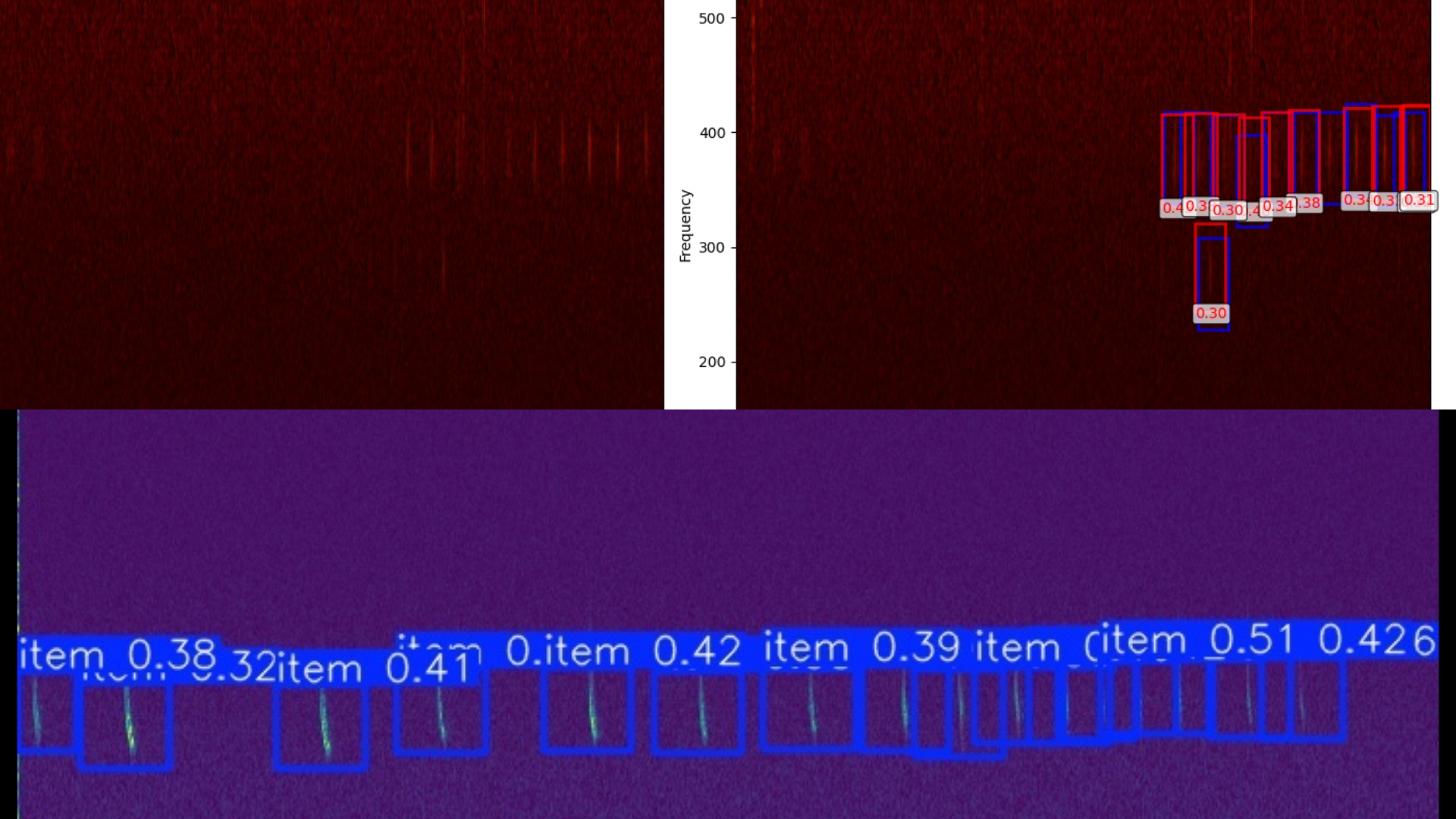
Trained on millions of examples
The model is curated by 12 bat experts across five European countries and retrained every weekend. 3.5 million noise files teach the AI to reject rain, wind, insects, and equipment noise before classification.
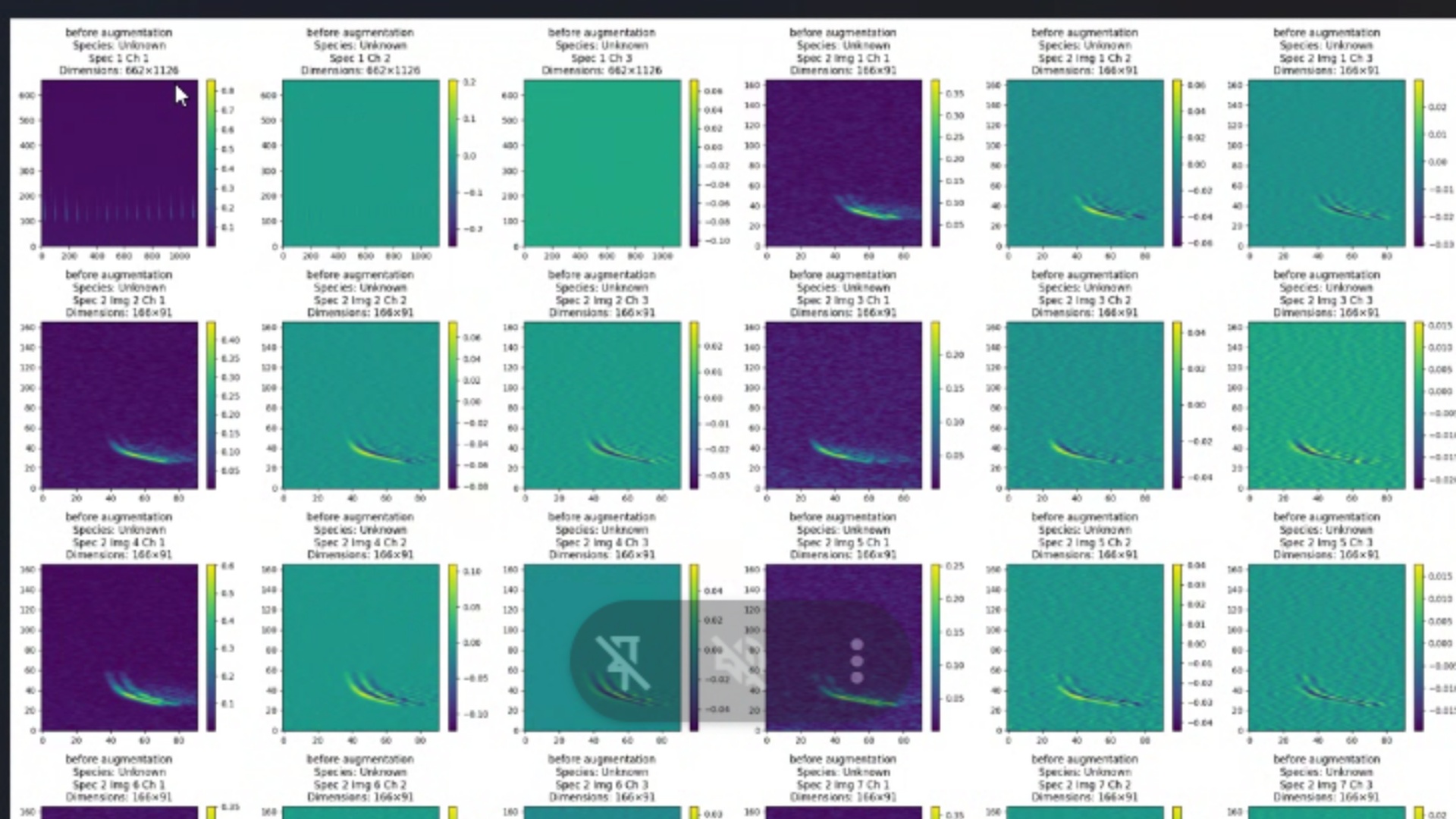
In the same Wilder Sensing benchmark, BioSonic was tested on 6,126 bat calls and scored 98.7% F1. BTO Acoustic Pipeline couldn’t be benchmarked the same way — the report concluded:
“BTO Pipeline is the least suitable bat analysis software … due to the inability to manually validate the AutoID results using the BTO Pipeline platform.”
According to the Wilder Sensing benchmark report 2026:
| Metric | BioSonic | BTO Acoustic Pipeline |
|---|---|---|
| F1 score | 98.7% | Not benchmarkable* |
| Manual validation | Right-click on spectrogram | Not supported on platform |
| False detections of impossible species | None | Greater horseshoe (validated as Noise) & Escalera’s bat (rare vagrant) — neither present in survey region |
| File handling | Any length, any folder size | Auto-splits into 5-sec segments → inflated counts & more NoIDs |
| RAG score (Wilder Sensing) | 16 / 18 | 9 / 18 — lowest of all 3 tools tested |
*BTO could not be benchmarked because the platform does not support manual validation of AutoID results, and the CSV output is only compatible with Analook Insight, an outdated analysis tool.
Have labelled recordings? We will run a free comparison.
“BTO Pipeline is the least suitable bat analysis software for Wilder Sensing.”
“BTO falsely detected Greater horseshoes with high confidence levels — but they were validated as Noise files.”
— On BTO’s false positives in Norfolk
“Cannot manually validate results. The csv. output file is only compatible with Analook Insight, an outdated bat analysis software.”
— On the validation gap
Spectrogram review
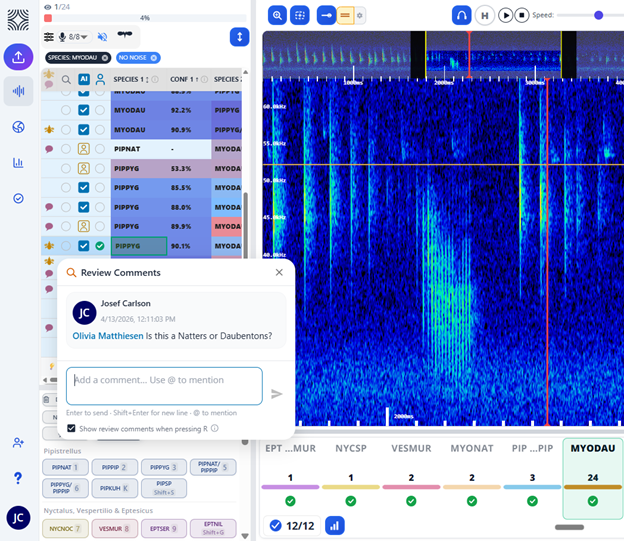
Inspect every call visually. Confirm or override AI classifications with right-click bounding boxes. Every decision is logged with a timestamp and user ID.
BTO returns classification files. Review happens in spreadsheets.
Species heatmaps
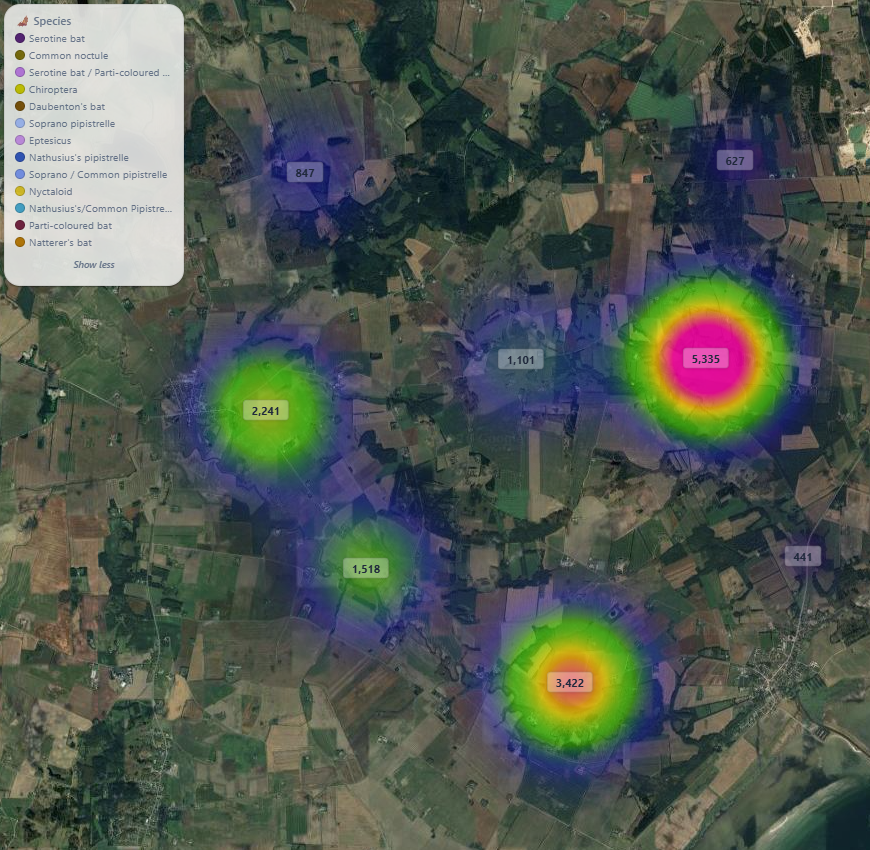
See bat activity across your entire site on an interactive map. Filter by species, date, or time of night. One click to export.
BTO does not include mapping. You build maps manually.
Emergence time analysis
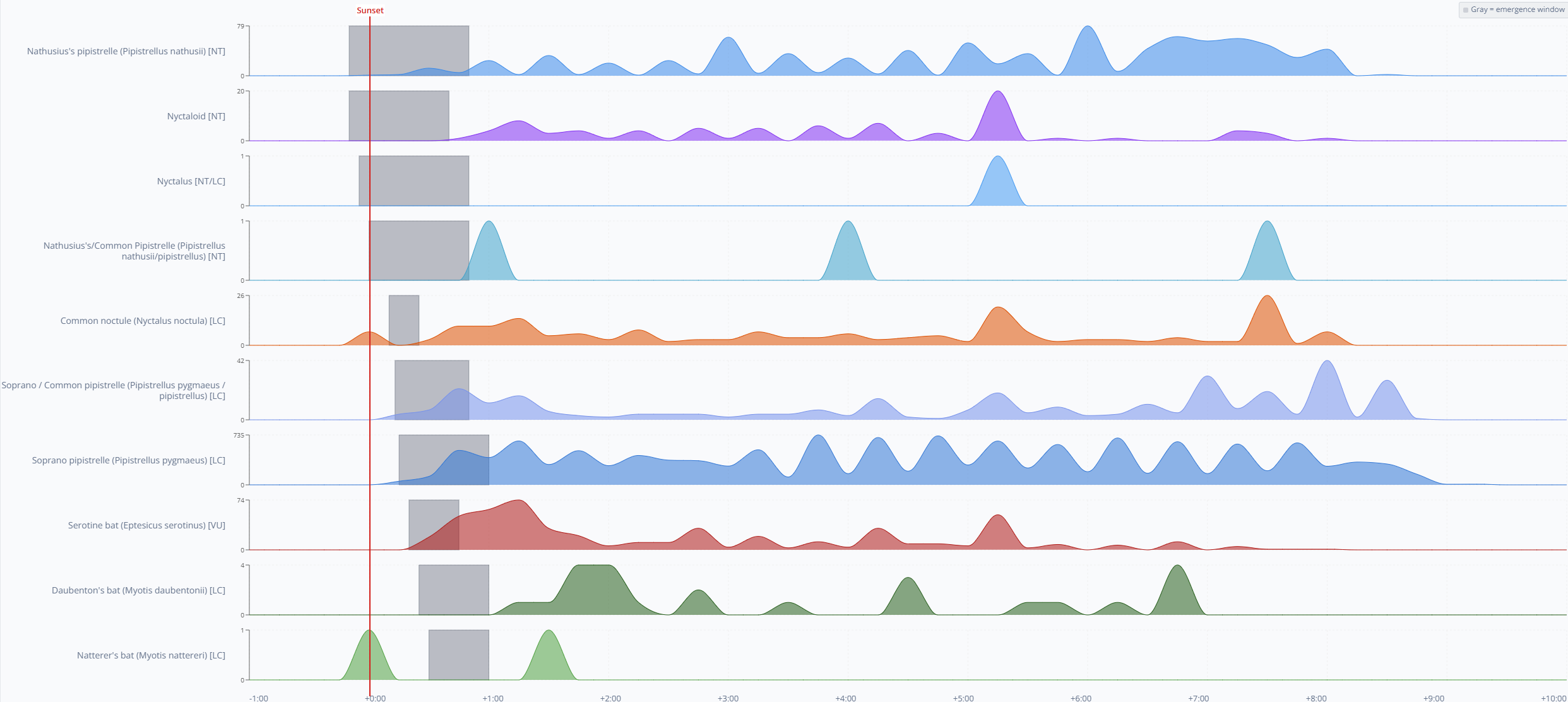
Automatic emergence graphs pinpoint when bats leave roosts. Crucial for roost characterisation reports.
With BTO, building emergence graphs takes weeks of manual Excel work.
Weather integration
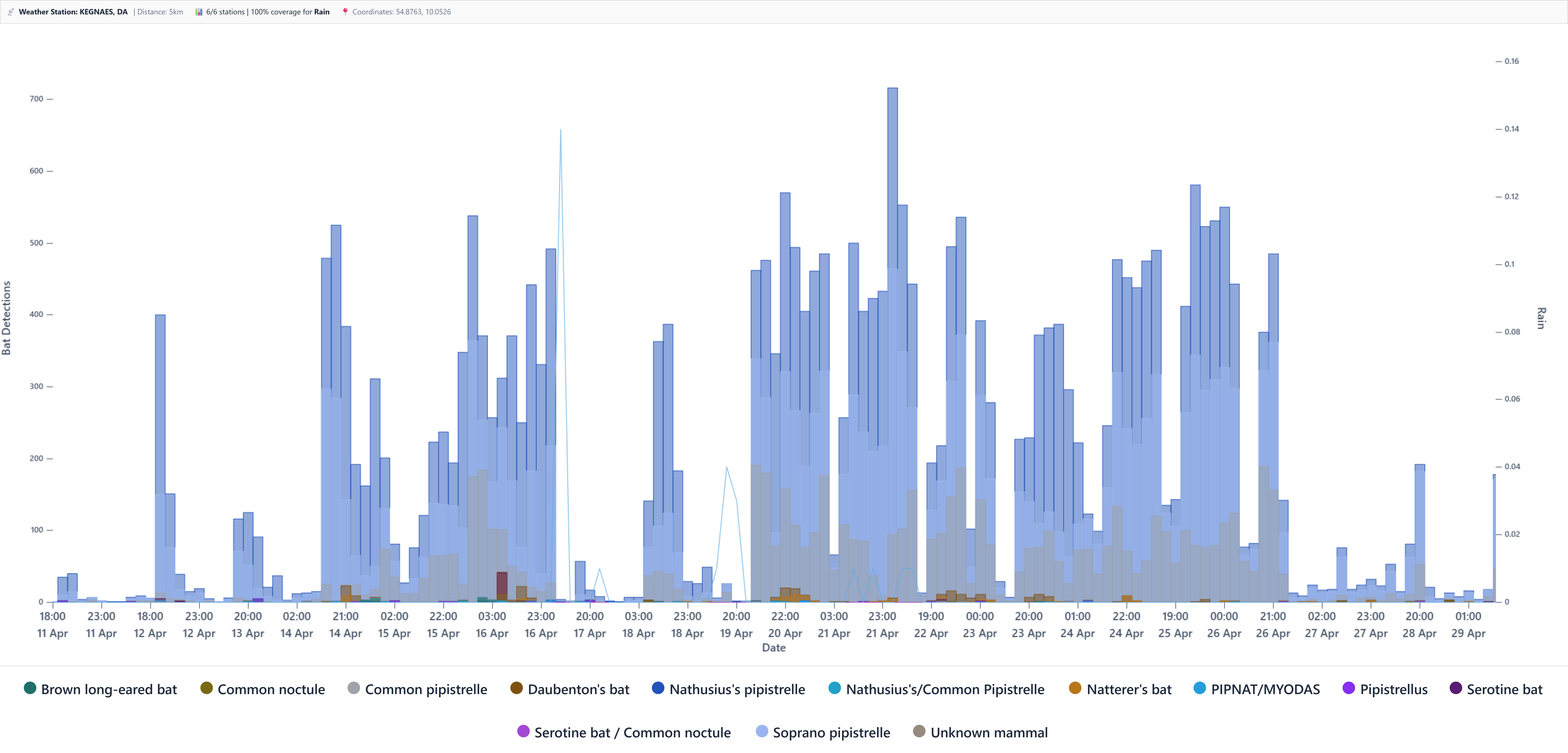
BioSonic automatically overlays temperature, wind, and rain data on your activity charts. No manual data entry.
BTO does not integrate weather data. You source and merge it yourself.
Direct quotes from bat ecologists who have used both tools.
Since joining BioSonic our analysis time has reduced significantly. The team is excellent in their support, super quick to respond.
— Luke Waddison, Senior Ecologist, Wharton (UK)
Choose BioSonic
- Consultancy team — more than one person writing environmental reports
- Integrated spectrogram review + AI analysis in one place
- Data stays private — no sharing required
Choose BTO
- Need non-bat taxa — birds, small mammals, bush-crickets
Some teams use both — BTO for non-bat taxa, and BioSonic for commercial bat projects where privacy and teamwork matter.
Is the BTO Acoustic Pipeline free?
BTO offers a free tier of 100 credits per year (roughly 100 GB), but it requires you to share your recordings with BTO for classifier training. If you cannot share data — for example, because of client NDAs — standard pricing is £1.40 per GB with no data-sharing requirement. Bespoke Projects start from £573.
Can I use BioSonic for UK bat species?
Yes. BioSonic supports all UK bat species and is used by UK-based consultancies for commercial survey work. The AI model is trained on 2.5 million bat calls spanning European species, including all 18 UK breeding species.
Does the BTO Acoustic Pipeline store my recordings?
Not by default. Recordings are processed and results returned, but long-term storage is not included unless arranged as part of a bespoke project. BioSonic includes 9 years of EU-hosted storage as standard.
How does accuracy compare between BioSonic and BTO?
In a third-party benchmark by Wilder Sensing, BioSonic scored 98.7% F1 on 6,126 calls across 15 species. BTO Acoustic Pipeline could not be benchmarked the same way — the report found that BTO’s platform does not support manual validation of AutoID results, and concluded it was “the least suitable” of the three tools tested. BTO also falsely detected impossible species (Greater horseshoe bats validated as Noise) and inflated detection counts by auto-splitting files into 5-second segments. See full benchmark results.
Can my whole team use BioSonic on one account?
Yes. BioSonic supports unlimited users per organisation with shared projects, in-app review queues, and a full audit trail. There are no per-seat fees. BTO Acoustic Pipeline does not include in-platform team features.
What bat detectors work with each platform?
Both BioSonic and BTO Acoustic Pipeline accept WAV files from any bat detector. Audiomoth, Wildlife Acoustics, Pettersson, Batlogger, Elekon — if it produces WAV output, it works with both platforms.
Can I switch from BTO Acoustic Pipeline to BioSonic?
Yes. There is no format lock-in. Upload your WAV files to BioSonic and results are typically ready within hours. You can run both platforms in parallel on the same recordings. Start a free trial to test it with your own data.
- Bas, Y. et al. (2017). "Tadarida: A toolbox for animal detection on acoustic recordings." J. Open Res. Softw. 5(1):6
- Gillings, S. & Scott, C. (2021). CNN classifiers for bird sound identification — BTO Research Report
- Wilder Sensing (2025). Third-party benchmark report — BioSonic scored 98.7% F1; BTO rated least suitable of three tools tested. See benchmarks page
- BTO Acoustic Pipeline pricing: bto.org
Last verified: 2026-04-26.
BioSonic vs Kaleidoscope Pro
98.7 percent F1 vs 73.0 percent. 13.4x fewer false positives. Cloud vs desktop.
BioSonic vs SonoBat UK
Cloud AI vs 30 years of desktop vetting. UK plus 4 more countries vs UK only.
BioSonic vs BatExplorer
Any detector vs Elekon-only. Cloud team vs Windows desktop.
Ready to try it?
See how BioSonic handles your recordings
Upload a batch of WAVs and compare results against your current workflow. No commitment, no credit card, no data sharing required.
Questions? Email josef.carlson@biosonic.se