
BioSonic vs BatSound
BatSound is Windows sound analysis software made by Pettersson Elektronik in Uppsala, Sweden, built for recording, viewing and measuring bat calls by hand. BioSonic is a Swedish cloud platform that identifies European bat species automatically from bat detector recordings (WAV, FLAC or Anabat zero-crossing) and lets a whole team review the results in the browser. Choose BatSound if you want detailed manual call measurement on your own PC; choose BioSonic if you need to sort large volumes of recordings by species and share the checking across a team.
The two tools do different jobs, so this is less a contest than a question of fit. Below we compare what each one does, how they handle files and teams, and how some consultancies use both.
At a glance
Facts about BatSound come from Pettersson's own product pages and the BatSound user manual (version 4.7), linked in the references.
| Feature | BioSonic | BatSound |
|---|---|---|
| What it is | Cloud platform for automatic bat species identification and team review | Windows software for recording, viewing and measuring sounds, with tools for bat calls [2][3] |
| Made by | Biosonic AB, Stockholm, Sweden (founded 2024) | Pettersson Elektronik AB, Uppsala, Sweden (since 1983) [1] |
| Automatic species identification | Yes, up to 7 species per recording, with a confidence score per call | Not described in the product page or manual; Pettersson sells SonoChiro (by Biotope) separately [3][5] |
| Detailed call measurement | Interactive spectrogram review; confirm or correct each call | Spectrogram, oscillogram, power spectrum, pulse interval and pulse length analysis, automatic pulse parameters [3] |
| Feeding buzzes and social calls | Flagged automatically | Identified by the analyst |
| Noise filtering | Deep-learning noise model trained on 3.5 million noise files | Manual filters in the sound editor; frequency-selective recording trigger [2][3] |
| Platform | Web browser on any operating system; nothing to install | Windows desktop (product page lists Windows 8, 10 and 11) [2] |
| Works offline | No, analysis runs on BioSonic's servers | Yes, runs on your own PC [2] |
| Live recording | No, BioSonic analyses files you upload | Yes, through a sound card or Pettersson USB microphone; BatSound Touch for Windows tablets [2][4] |
| File formats | WAV and FLAC from full-spectrum detectors; Anabat zero-crossing (.zc, .NN#) converted on upload | WAV; mp3 and wma with codecs; zero-crossing not mentioned [2] |
| Team working | Whole team on one organisation account, shared projects, audit trail | Single-user licence (up to two computers, one at a time) or 5-user licence [2][3] |
| Pricing model | Package of analysis GB, lower price per GB for bigger packages; ask us for a quote; no per-seat fees | Per-user licence; check current terms with Pettersson |
| Published accuracy | 98.7% F1 in a third-party benchmark by Wilder Sensing | Not applicable: a measurement tool, results depend on the analyst |
How each tool works
BatSound: a measurement bench for sound
Pettersson describes BatSound as a tool for many types of sound analysis, with extra features for bat calls, especially calls recorded with a bat detector or directly with its D500X or D1000X recorders [1]. You open a file, look at it as a spectrogram, oscillogram or power spectrum, and measure what you see. Pulse interval and pulse length histograms, a sound editor with filtering, time-expansion handling and a "virtual bat detector" mode for learning calls are all built in [3].
Its Pulse Feature Analysis can extract pulse duration, start and end time, maximum and minimum frequency, bandwidth, frequency of maximum energy and maximum amplitude, for one file or for a set of files, and export the table to the clipboard or an HTML file [3]. What it does not do, according to its product page and manual, is decide the species for you. That judgement stays with the analyst.
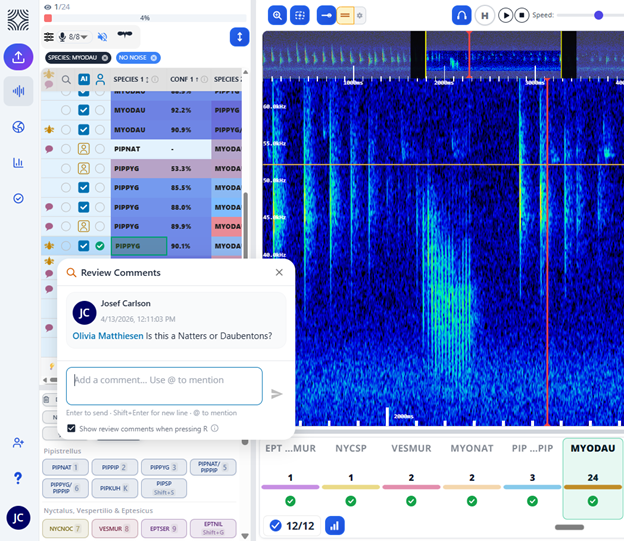
BioSonic: automatic sorting, human checking
BioSonic converts each recording into a spectrogram and runs deep-learning image recognition on it. The model is trained on more than 2.5 million verified bat calls and 3.5 million noise files from across Europe, curated by 12 bat experts, and it is retrained every weekend.
The output is a project where noise is filtered out, every pass has a species suggestion and confidence score, and feeding buzzes and social calls are flagged. You click through the spectrograms, confirm or correct, and every change is recorded against the person who made it. Detection tables per species, charts, maps and reports come straight out of the same project.
Accuracy and evidence
BioSonic scored 98.7% F1 in a third-party benchmark (Wilder Sensing, 5,325 predictions), ranked first of the classifiers tested. The method and results are on our benchmarks page [6].
There is no equivalent figure for BatSound, and there should not be: it is a measurement tool, not a classifier, so the accuracy of a BatSound identification is the accuracy of the person using it. Its measurements are as good as the recording and the settings you choose. A fair way to compare is to take a project you have already identified by hand in BatSound, upload the same WAV files to BioSonic, and see where the two agree.
Automatic identification has known limits. Myotis to species level and the Plecotus group are hard to separate on call alone, so BioSonic sends those to manual verification, which matches the Bat Conservation Trust's expectation that automated identifications are checked by a person [8].
I can click through it easily, find my file, find my sonogram, and look through those that I might be in doubt of. It's seldom wrong.
Lars Michael Nielsen, biologist, DMR (Denmark). Read the case study [7]
Workflow fit, and using both
Most bat teams do two different kinds of work: sorting a large pile of recordings into species and activity, and looking very closely at a handful of difficult calls. BatSound is strong at the second. BioSonic is built for the first, with a review screen for the checking that follows.
Choose BioSonic if you
- Run static detectors and come home with thousands of files per site
- Want noise filtered out and recordings sorted by species before anyone opens a spectrogram
- Work as a team and want one shared project instead of files on a shared drive
- Need detection tables, graphs and maps for reports without building them in Excel
- Work on more than one operating system, or want nothing to install
Choose BatSound if you
- Mainly measure individual calls in detail: frequencies, durations, pulse intervals, power spectra
- Record live into a Windows computer or tablet with a Pettersson microphone
- Need to work fully offline
- Handle small numbers of files, or use the software for teaching and learning calls
- Want a tool for any kind of sound, not only bats
Using both
The two fit together well because they read the same WAV files. A practical split: upload the season to BioSonic, let it filter noise and sort by species, review and confirm in the browser, and export the report tables. When a call is genuinely hard, open that one file in BatSound and measure it by hand. You keep the measurement bench you trust and lose the hours of opening files one by one.
What switching looked like for one Danish team
DMR, a Danish environmental consultancy, used BatSound for its bat surveys. Before switching, its team kept files on a shared drive, built sonograms one by one and emailed files back and forth for a second opinion [7]. In summer 2025 they tested BioSonic on a single building survey. Their biologist reported that it saved at least 10 hours on that one project. By spring 2026 the whole bat team had moved over, with seven users sharing one workspace [7].
Detectors and file formats
BioSonic works with full-spectrum WAV files from AudioMoth, Wildlife Acoustics (Song Meter, including the SM4, and Echo Meter), Elekon Batlogger, Titley Anabat and Pettersson Elektronik detectors. You upload files as recorded, with no conversion. BioSonic also accepts FLAC, and Anabat zero-crossing files (.zc and .NN# sequence files, such as .03#), which it converts on upload. Its benchmarked accuracy is for full-spectrum WAV, so record full spectrum where you can.
BatSound stores recordings as WAV, records at up to 384 kHz, opens files at any sampling rate, and can open mp3 or wma when the right codecs are installed [2]. It handles time-expanded recordings by applying a time expansion factor to the axes [3]. Pettersson's product page does not mention zero-crossing files [2]. Pettersson highlights calls recorded with its own D500X and D1000X recorders [1].
Pricing model
BioSonic is sold as a package of analysis gigabytes. The bigger the package, the lower the price per GB. There are no per-seat fees, and your whole team uses one organisation account. All features and model updates are included, and your recordings are kept for 9 years. Book a call for a quote for your volume.
BatSound is sold per user. Pettersson offers a single-user licence and a 5-user licence [2]. Under the licence agreement in the manual, a single-user licence may be installed on up to two computers as long as only one is in use at a time; using it on more computers at once needs another licence or a multi-user licence [3]. For prices and whether upgrades are included, check with Pettersson.
Data and collaboration
BioSonic keeps your recordings and results in the EU, mainly in Sweden, with uploaded audio in encrypted storage. Your recordings are kept for 9 years, you can export your data at any time, and you can ask for full deletion. Everyone in your organisation sees the same projects, and every confirmation or correction is attributed, which gives you an audit trail for reports. See our security page for detail.
BatSound keeps everything on your own computer, which suits people who prefer data never to leave the office. Its product page and manual do not describe a shared online workspace [2][3], so teams share sound files and exported results through their own folders or email.
Frequently asked questions
Is BatSound an automatic bat species classifier?
No. BatSound is sound analysis software for recording, viewing and measuring calls, and neither its product page nor its user manual describes automatic species identification [2][3]. It can measure pulse parameters automatically (duration, minimum and maximum frequency, bandwidth, frequency of maximum energy), but deciding the species is up to you. Pettersson sells SonoChiro, made by Biotope, as a separate product for automatic identification [5].
Can I keep BatSound and use BioSonic as well?
Yes. Both work on full-spectrum WAV files, so a team can let BioSonic sort a season of recordings by species and keep BatSound for detailed measurement of individual calls. Nothing needs converting between the two.
Would BioSonic replace manual analysis?
No, it moves manual analysis to the calls that need it. BioSonic filters noise, sorts recordings by species and gives every call a confidence score, and you confirm or correct the results on the spectrogram. Myotis to species and Plecotus still need manual verification, in line with BCT good-practice guidance [8].
Do we install BioSonic ourselves like BatSound, or do you run the analysis?
We run the analysis. You upload WAV files in a web browser, the AI runs on BioSonic's servers, your data is stored in the EU, mainly in Sweden, and the results come back in the same browser tab. BatSound, by contrast, is installed and runs on your own Windows PC [2].
Is BioSonic a licence per computer like BatSound, or based on gigabytes?
BioSonic is based on gigabytes: you buy a package of analysis gigabytes, and the bigger the package, the lower the price per GB. There are no per-seat fees and your whole team is on one organisation account. BatSound is sold as a single-user licence (installable on up to two computers, used on one at a time) or a 5-user licence; check current terms with Pettersson [2][3].
Can several people on our team work at the same time?
Yes. In BioSonic everyone in your organisation works in the same shared projects in the browser, and every confirmation or correction is logged against the reviewer. The Danish consultancy DMR moved its bat team from BatSound to BioSonic and now has seven users in one workspace (case study).
Does BioSonic work with Pettersson detectors?
Yes. BioSonic reads WAV and FLAC files from Pettersson Elektronik detectors, as well as AudioMoth, Wildlife Acoustics Song Meter and Echo Meter, Elekon Batlogger, Titley Anabat and other full-spectrum detectors, plus Anabat zero-crossing files. Upload them as recorded; no conversion is needed.
Does BioSonic analyse zero-crossing files?
Yes, BioSonic accepts Anabat zero-crossing files (.zc and .NN# sequence files) and converts them on upload. Its benchmarked accuracy is for full-spectrum WAV, so record full spectrum where you can. BatSound's product page lists WAV (plus mp3 and wma with the right codecs) and does not mention zero-crossing files [2].
Prefer another language? Fladdermus ljudanalys explains BioSonic for Swedish bat surveys and wind power work, in Swedish.
Other comparisons
BioSonic vs Kaleidoscope Pro
Cloud AI vs Wildlife Acoustics' desktop classifier, compared on the same benchmark.
BioSonic vs BatExplorer
Any detector vs Elekon's Windows desktop tool.
BioSonic vs SonoBat UK
Cloud review for teams vs a long-standing desktop vetting tool.
References
- Pettersson Elektronik AB, company and product overview: batsound.com
- Pettersson Elektronik, BatSound product page (version 4.7, system requirements, file formats, licences): batsound.com/product/batsound
- Pettersson Elektronik, BatSound user manual, version 4.7 (feature list, Pulse Feature Analysis, licence agreement): batsound.com/inc/files/pdf/BatSoundManual.pdf
- Pettersson Elektronik, BatSound Touch product page: batsound.com/product/batsound-touch
- Pettersson Elektronik, SonoChiro product page (automatic identification software by Biotope): batsound.com/product/sonochiro
- Wilder Sensing, third-party benchmark, 5,325 predictions: biosonic.io/benchmarks
- DMR case study, how a Danish consultancy replaced BatSound with BioSonic: biosonic.io/dmr
- Bat Conservation Trust, guidelines for passive acoustic surveys of bats in woodland (manual verification of automated identifications): bats.org.uk
Competitor facts last checked: 2026-11-17.
Ready to try it?
See how BioSonic handles your recordings
Upload one project you have already analysed in BatSound and compare. No commitment, no installation required.
Questions? Email josef.carlson@biosonic.se