
BioSonic vs BatDetect2: open-source deep learning and a ready-to-use bat ID service compared
BatDetect2 is a free deep learning model and Python tool from Oisin Mac Aodha and colleagues that finds bat echolocation calls in recordings and classifies them to species; its default model is trained on UK data, the authors report a mean average precision of 0.88 on a 17-species UK dataset, and it is licensed for non-commercial use only (CC BY-NC 4.0). BioSonic is a Swedish cloud service that identifies European bat species from detector recordings (WAV, FLAC or Anabat zero-crossing) in the browser, with nothing to install and team review built in. Choose BatDetect2 for non-commercial research where you can run, validate or retrain a model yourself; choose BioSonic for paid survey work and teams that want checked results without setting up software.
BatDetect2 is a strong, openly published research tool, and BioSonic is a commercial service. Below we compare what each does, what the licence allows, where each model was trained, and how researchers can use both.
At a glance
Facts about BatDetect2 come from its GitHub repository, documentation, licence file and paper, linked in the references. We checked the repository on 2026-11-18, when the newest release was the 2.0.0b3 beta and 1.3.1 the latest stable release [6].
| Feature | BioSonic | BatDetect2 |
|---|---|---|
| What it is | Cloud service for automatic bat species identification and team review | Deep learning model plus a Python tool to run, train, fine-tune and evaluate it [1] |
| Made by | Biosonic AB, Stockholm, Sweden (founded 2024) | Oisin Mac Aodha, Santiago Martínez Balvanera and co-authors; academic research project [5][7] |
| Licence and cost | Commercial service with a free trial; package of analysis GB, ask for a quote | Free to download; CC BY-NC 4.0, non-commercial use only [2][3] |
| Species covered | European bat species, up to 7 species per recording | Default model trained on UK data; paper reports a 17-species UK dataset [1][7] |
| Train your own model | BioSonic trains the model centrally and deploys a new one every weekend | Yes, train or fine-tune on your own annotated recordings and species list [1][3] |
| Output | Species suggestion and confidence score per call, feeding buzzes and social calls flagged, export to CSV or Excel | Each call boxed in time and frequency, with a detection probability and species probabilities; JSON and CSV per recording, Parquet optional [3][4] |
| Human review | Review screen in the browser: confirm or correct each call, every change logged | No review screen described; annotations from Whombat or an earlier BatDetect2 annotation GUI can be imported for training [1] |
| Setup | Web browser on any operating system; nothing to install | Install with uv or pip; command line or Python; 2.0 beta needs Python 3.10 to 3.13 [1][5] |
| Try without installing | Free trial in the browser | Hugging Face demo (UK species) and Google Colab notebook [1][8] |
| File formats | WAV and FLAC, any file length; Anabat zero-crossing (.zc, .NN#) converted on upload | Folder of WAV files; zero-crossing and frequency-division not directly supported [1][3] |
| Where it runs | BioSonic's servers; data stored in the EU, mainly in Sweden | Your own computer; a GPU is often much faster than a CPU [3] |
| Team working | Whole team on one organisation account, shared projects, audit trail | Not described in the README; you organise files and review yourself [1] |
| Published accuracy | 98.7% F1 in a third-party benchmark by Wilder Sensing, against 83.0% for Kaleidoscope Pro [10] | Mean average precision 0.88 on the authors' 17-species UK dataset, against 0.71 for a call-parameter baseline [7] |
| Head-to-head test | None. BioSonic and BatDetect2 have not been benchmarked on the same recordings. | |
How each tool works
BatDetect2: an open model you run yourself
BatDetect2 is a deep learning model that detects and classifies bat echolocation calls in one pass. For each recording it draws a bounding box around every call it finds and predicts a class for it [1]. The method is described in the bioRxiv preprint "Towards a General Approach for Bat Echolocation Detection and Classification" (Mac Aodha et al., 2022), which tested it on five datasets from the UK, Mexico, Australia and Brazil [7].
You install the batdetect2 package and run batdetect2 process directory on a folder of WAV files. By default it uses the built-in UK model and writes one JSON file and one detections CSV per recording, with the species, a class probability, a detection probability, and the time and frequency bounds of each call [1][4]. You can raise or lower the detection threshold, load a different checkpoint, or train and fine-tune your own model [3]. The authors say the tool does no sophisticated post-processing across a sequence of calls: it returns a probability for each species for each call, and you can use those to clean up sequences yourself [3].
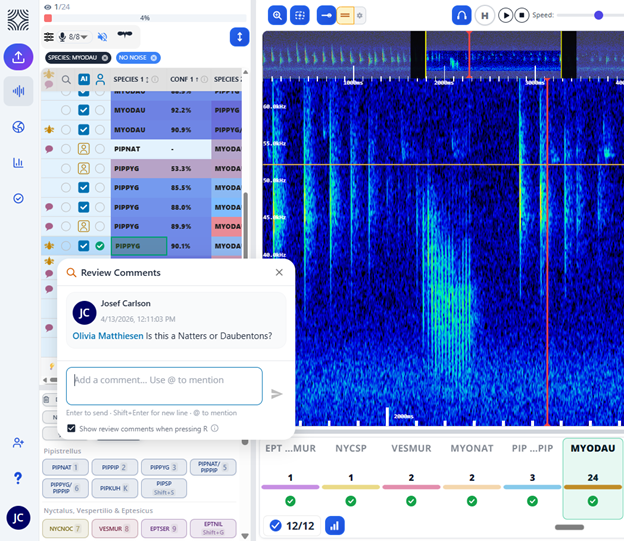
BioSonic: a service with review built in
BioSonic converts each recording into a spectrogram and runs deep-learning image recognition on it. The model is trained on more than 2.5 million verified bat calls and 3.5 million noise files from across Europe, curated by 12 bat experts, and a new model is trained and deployed every weekend.
You upload WAV, FLAC or Anabat files in the browser, from AudioMoth, Song Meter, Batlogger and other detectors, at any file length. Noise is filtered out, every pass gets a species suggestion and confidence score, and feeding buzzes and social calls are flagged. Your team clicks through the spectrograms, confirms or corrects, and every change is recorded against the person who made it. Detection tables, charts, maps and exports to CSV or Excel come out of the same project.
Accuracy and evidence
There is no benchmark of BioSonic against BatDetect2. We have not tested the two on the same recordings, and we know of no one who has published such a test. The two figures below come from different studies, with different metrics and different data, so they should not be put side by side as if one beat the other.
BioSonic scored 98.7% F1 in a third-party benchmark by Wilder Sensing (5,325 predictions), against 83.0% for Kaleidoscope Pro, with 13.4 times fewer false positives and 16.3 times fewer missed bats. The method and results are on our benchmarks page [10].
BatDetect2's authors report a mean average precision of 0.88 on a UK dataset with 17 bat species, against 0.71 for a traditional call-parameter extraction baseline [7]. That is good detection and classification performance on UK data. The authors are careful about how far it carries: their README says the models "should be used with caution" and very strongly recommends validating on data with known species before using outputs for biodiversity assessment [1]. Their FAQ adds that insects or noise can be confused with bats when recording conditions differ from training conditions, and that feeding buzzes and social calls are a known limitation in some settings [3].
Some limits apply to every automatic classifier. Myotis to species level and the Plecotus group are hard to separate on call alone, so BioSonic sends those to manual verification, in line with the Bat Conservation Trust's expectation that automated identifications are checked by a person [12]. If you want a direct answer for your own sites, run the same verified recordings through both tools and compare.
Licence and cost
BatDetect2 is free to download, but its licence file is the Creative Commons Attribution-NonCommercial 4.0 International licence (CC BY-NC 4.0) [2]. The licence grants the right to reproduce and share the material, and adapted versions, for NonCommercial purposes only, and defines NonCommercial as "not primarily intended for or directed towards commercial advantage or monetary compensation" [2][9]. The project FAQ puts it plainly: asked whether it can be used for commercial purposes, it answers no, the project is currently for non-commercial use [3]. For paid consultancy work, read the licence and ask the authors.
BioSonic is a commercial service built for paid survey work. You buy a package of analysis gigabytes; the bigger the package, the lower the price per GB, and recordings are kept for 9 years. There is a free trial, and you can ask for a quote.
When to choose BatDetect2
BatDetect2 is a good choice when the work is non-commercial and you want control over the model itself.
BatDetect2 fits if you
- Do non-commercial research, teaching or volunteer work that the licence covers
- Survey UK bats and can validate the default model on your own known recordings
- Want to train or fine-tune a model on your own annotated calls or species list, for example outside the UK
- Are comfortable with the command line or Python and want outputs you can analyse in Python or R
- Need to keep processing on your own machine, ideally with a GPU
- Want a published, citable method for a paper
Other free UK options
- BatClassify, which Titley ships as a plugin in Anabat Insight, identifies UK woodland bats and analyses full-spectrum WAV only [11]. See BioSonic vs Anabat Insight.
- For a wider list of free and paid tools, see Kaleidoscope Pro alternatives.
When to choose BioSonic
BioSonic is a good choice when the work is paid, the volumes are large, or the team should not have to run software.
BioSonic fits if you
- Do commercial survey or consultancy work
- Survey bats across Europe, not only in the UK
- Run static detectors such as AudioMoth and come home with thousands of files per site, at any file length
- Want noise filtered and recordings sorted by species before anyone opens a spectrogram
- Work as a team and want one shared project with an audit trail instead of folders of CSV files
- Want nothing to install and a new AI model every weekend without updates on your side
What you give up
- You do not train the model yourself; BioSonic does
- Analysis runs on BioSonic's servers, so you need an internet connection
- It is a paid service after the free trial
Using both
The two fit together because both read full-spectrum WAV files. A university group, for example, might use BatDetect2 for a thesis where it wants to train its own model, report the method and share the code, and use BioSonic for paid survey contracts where a team needs to review and report on a season of recordings quickly.
Running both on the same set of verified recordings is also the fairest way to see how each performs on your own detectors, habitats and species. BatDetect2 gives you per-call probabilities in CSV or JSON; BioSonic exports every identified recording with date and time to CSV or Excel. Compare the two exports against your verified labels, and look closely at Myotis, Plecotus, feeding buzzes and noisy nights, where every classifier is tested hardest.
Frequently asked questions
Can BatDetect2 identify European bats outside the UK?
Not with its default model alone. BatDetect2's built-in model is trained on UK data, and the paper reports results on a UK dataset of 17 bat species [1][7], so a species outside its training classes cannot be named by it. The authors say performance drops when your data differ from the training data, and they very strongly recommend validating the model on recordings with known species first [1][3]. The software does let you train or fine-tune a model on your own annotated recordings and species list, and the paper applied the same pipeline to data from Mexico, Australia and Brazil [3][7]. BioSonic's model covers European bat species out of the box.
Is BatDetect2 free for consultancy work?
No, not under its published licence. BatDetect2 is released under the Creative Commons Attribution-NonCommercial 4.0 International licence (CC BY-NC 4.0), which only allows use and sharing for NonCommercial purposes, defined as "not primarily intended for or directed towards commercial advantage or monetary compensation" [2][9]. The project's own FAQ answers "Can I use this for commercial purposes?" with "No. This project is currently for non-commercial use." [3] If you want to use it for paid work, ask the authors. BioSonic is a commercial service built for paid survey work.
Has BioSonic been benchmarked against BatDetect2?
No. We know of no test that runs BioSonic and BatDetect2 on the same recordings. BioSonic scored 98.7% F1 in a third-party benchmark by Wilder Sensing, against 83.0% for Kaleidoscope Pro [10]. The BatDetect2 authors report a mean average precision of 0.88 on their own 17-species UK dataset [7]. These are different metrics on different data, so they cannot be compared. The fair test is to run both on a set of your own verified recordings.
Does BatDetect2 work with AudioMoth recordings?
BatDetect2 documents a folder of WAV files as its input, and AudioMoth records WAV, so you can point it at AudioMoth files [1]. The authors do not list supported detectors; they ask you to validate the model on your own recordings first. It does not directly handle zero-crossing or frequency-division recordings [3]. BioSonic accepts AudioMoth WAV files as recorded, at any file length, as well as FLAC and Anabat zero-crossing files (see detector compatibility).
Do I need to know Python to use BatDetect2?
Not much, according to its authors. You install it with uv or pip and run one command on a folder of recordings; some command-line familiarity helps, and the Python package is there if you want to build it into your own pipeline [1][3]. Version 2.0 (a beta, 2.0.0b3) needs Python 3.10 to 3.13 [5]. To try it without installing, there is a Hugging Face demo for UK species and a Google Colab notebook [1][8]. BioSonic runs in the browser with nothing to install.
Can I use BatDetect2 and BioSonic together?
Yes. Both read full-spectrum WAV files. A research group can use BatDetect2 for non-commercial work where it wants to train, inspect or publish its own model, and use BioSonic for paid surveys, team review and reports. Running both on the same verified recordings is also a simple way to see how each performs on your sites.
Other comparisons
BioSonic vs BTO Acoustic Pipeline
Two cloud classifiers for European bats, compared on workflow and data sharing.
BioSonic vs Kaleidoscope Pro
Cloud AI vs Wildlife Acoustics' desktop classifier, compared on the same benchmark.
BioSonic vs Anabat Insight
Automatic ID in the browser vs Titley's desktop toolbox with the BatClassify plugin.
References
- BatDetect2 repository README (what it is, default UK model, install, run on a folder of WAV files, demos, validation warning): github.com/macaodha/batdetect2
- BatDetect2 licence file, Creative Commons Attribution-NonCommercial 4.0 International: github.com/macaodha/batdetect2/blob/main/LICENSE.md
- BatDetect2 FAQ (Python knowledge, performance on other data, noise and insects, feeding buzzes, per-call species probabilities, zero-crossing, training your own species set, commercial use): github.com/macaodha/batdetect2/blob/main/docs/source/faq.md
- BatDetect2 tutorial, run on a folder of recordings (output files and fields): github.com/macaodha/batdetect2/blob/main/docs/source/tutorials/run-inference-on-folder.md
- BatDetect2 package metadata (version 2.0.0b3, Python 3.10 to 3.13, authors, licence): github.com/macaodha/batdetect2/blob/main/pyproject.toml
- BatDetect2 on PyPI (release history; 1.3.1 is the latest stable release, 2.0.0b3 a pre-release): pypi.org/project/batdetect2
- Mac Aodha, O., Martínez Balvanera, S., Damstra, E. et al. (2022) Towards a General Approach for Bat Echolocation Detection and Classification. bioRxiv preprint: biorxiv.org/content/10.1101/2022.12.14.520490v1
- BatDetect2 demo for UK species on Hugging Face: huggingface.co/spaces/macaodha/batdetect2
- Creative Commons, Attribution-NonCommercial 4.0 International legal code: creativecommons.org/licenses/by-nc/4.0/legalcode
- Wilder Sensing, third-party benchmark, 5,325 predictions: biosonic.io/benchmarks
- Titley Scientific, frequent questions answered (BatClassify plugin: UK woodland bats, full-spectrum WAV only): titley-scientific.com/support/frequent-questions-answered
- Bat Conservation Trust, guidelines for passive acoustic surveys of bats in woodland (manual verification of automated identifications): bats.org.uk
Competitor facts last checked: 2026-11-18.
Ready to try it?
See how BioSonic handles your recordings
Upload a set of recordings you have already verified, or already run through BatDetect2, and compare. No commitment, no installation required.
Questions? Email josef.carlson@biosonic.se