NATURE SPEAKS. WE TRANSLATE.
The most accurate bat sound analysis available.
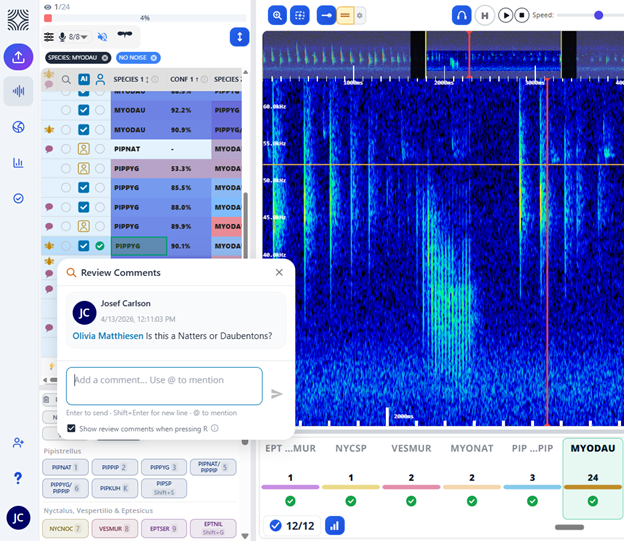
BioSonic uses image recognition on spectrograms to identify bat species, filter noise, and separate feeding and social calls — automatically.
Try 15 GB for free
BioSonic uses image recognition on spectrograms to identify bat species, filter noise, and separate feeding and social calls — automatically.
Try 15 GB for free





















Two independent studies — one from UK sensor platform Wilder Sensing, one from Denmark's leading bat expert — plus a direct comparison against Kaleidoscope Pro on the same dataset.
BioSonic scores 98.7% F1 vs Kaleidoscope Pro’s 73.0% F1 — a 25.7 point gap. Kaleidoscope produces 17× more false positives and 16× more false negatives.
Source: Table 1 — Wilder Sensing validation study, Grassland + Paludiculture combined datasets (strict matching; Kaleidoscope Pro NoIDs not rewarded as true positives).
Five detectors, 11 species, one conclusion: BioSonic reaches identical ecological conclusions as manual analysis — same detector ranking (which monitoring locations had the most bat activity), same patterns — while catching more rare and protected species.
D4 > D5 > D2 > D1 > D3 — same order whether counted by hand or by AI
BioSonic detects more Pipistrel (+203%) and Trold (+16%)
Separate scale — these are the ones that matter for Annex II compliance
Positive = BioSonic found more; Negative = Manual found more
Grouped by echolocation type — differences shrink dramatically at group level.
Species with large % differences make up tiny fractions of total.
| Danish | Scientific | Phonic Group | Manual | BioSonic | Diff | Diff % | Expert Comment |
|---|---|---|---|---|---|---|---|
| Dværg | P. pygmaeus | Pipistrellus | 13,556 | 10,669 | -2,887 | -21.3% | Redistribution within Pip group |
| Trold | P. pipistrellus | Pipistrellus | 11,433 | 13,248 | +1,815 | +15.9% | “More or less the same” |
| Pipistrel | P. nathusii | Pipistrellus | 2,257 | 6,834 | +4,577 | +202.8% | Key migration species — likely noise recovery |
| Vand | M. daubentonii | Myotis | 112 | 221 | +109 | +97.3% | Confirmed correct, missed in noise files |
| Frynse | M. nattereri | Myotis | 11 | 100 | +89 | +809.1% | “They’re more or less all correct” — expert verified |
| Dam | M. dasycneme | Myotis | 0 | 0 | 0 | 0.0% | Agreement — no detections |
| Myotis sp. | Myotis sp. | Myotis | 63 | 0 | -63 | -100% | BioSonic classified to species — “no problem” |
| Brun | N. noctula | Nyctaloid | 40 | 41 | +1 | +2.5% | Near-perfect match |
| Syd | P. kuhlii / E. serotinus | Nyctaloid | 55 | 67 | +12 | +21.8% | Close match for rare species |
| Skimmel | V. murinus | Nyctaloid | 1 | 0 | -1 | -100% | Single call — statistically negligible |
| Nyctaloid sp. | Nyctaloid sp. | Nyctaloid | 10 | 0 | -10 | -100% | BioSonic classified to species level |
| Total | 27,538 | 31,180 | +3,642 | +13.2% |
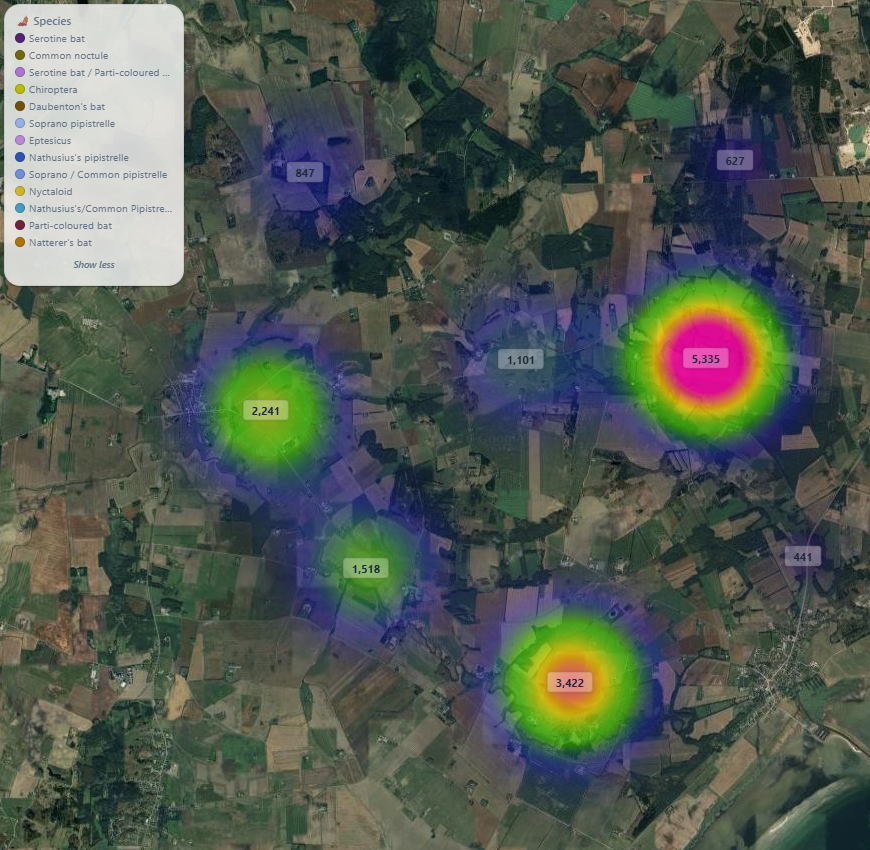
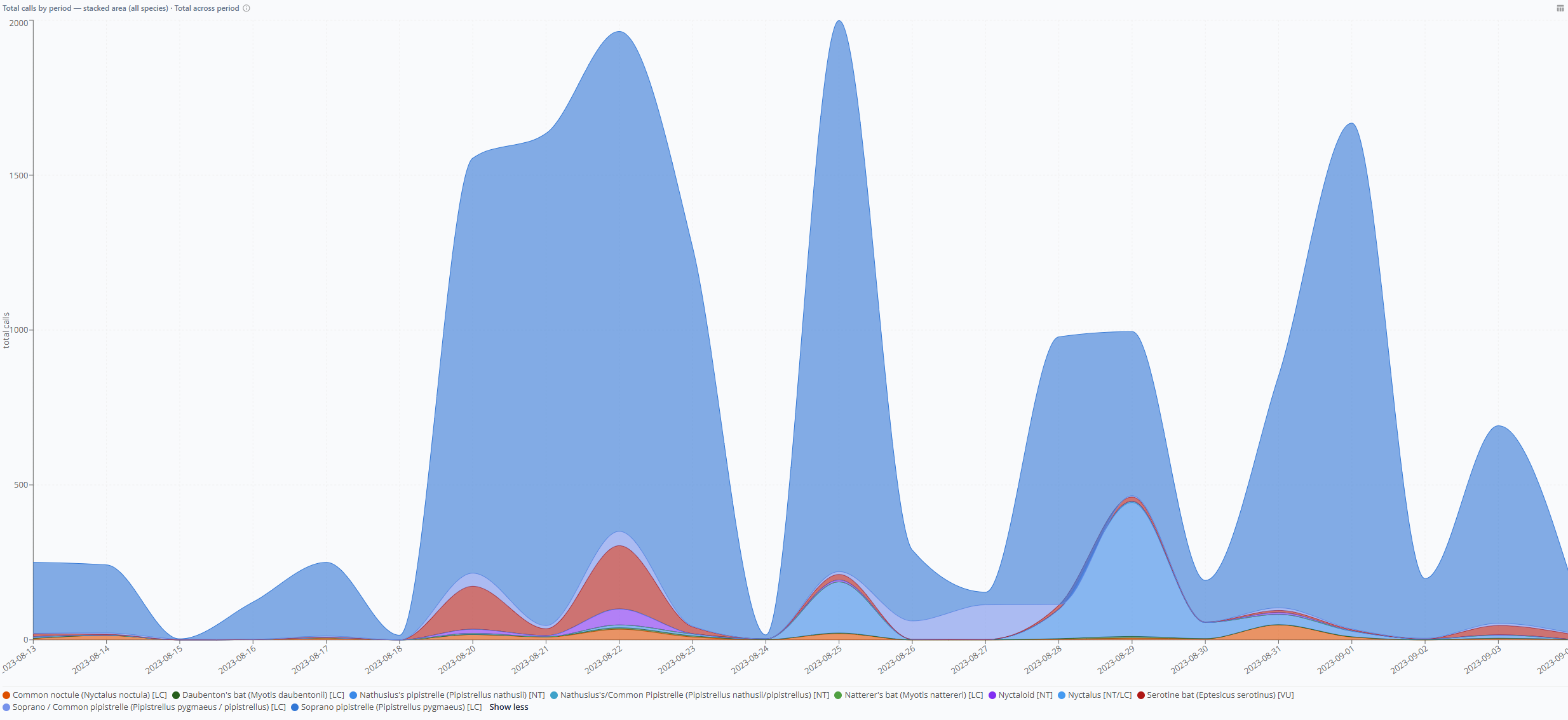
Every feature your team needs to analyse bat sound at scale — AI detection, spectrogram review, team collaboration and report-ready visualisations in a single platform.
Real comparison from an ecology consultancy in south England, measuring time spent on sound analysis between Kaleidoscope Pro and BioSonic on the same 2 TB dataset.




Unprompted, on the open internet — from ecology consultants who actually use the platform.


Start for free — or book a walkthrough.